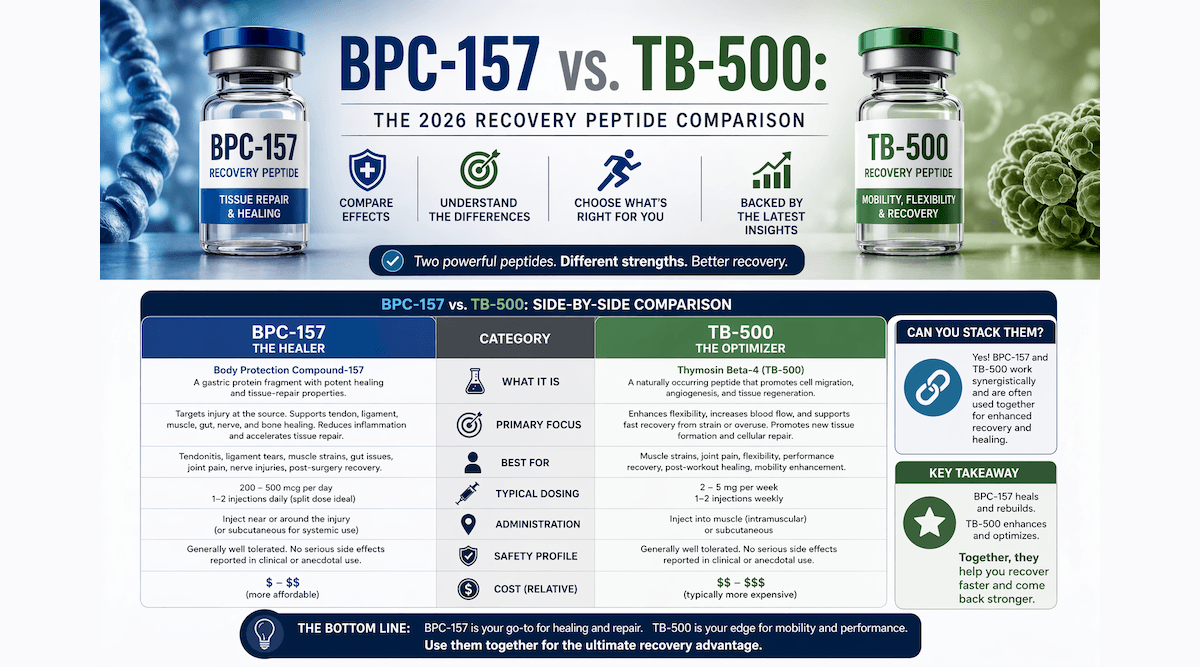
bpc 157 + tb 500 side effects BPC-157 vs TB-500: Complete Comparison (2026) Taking unapproved drugs such as
Description
For example, CMS article A57452 details billing and coding for these procedures, emphasizing the need for medical necessity documentation

Operators should stay engaged with industry news, attend conferences, and participate in professional development to keep skills sharp and systems compliant
The 5 mg vial and its volume caveat Reconstitute a 5 mg vial with 2 mL of bacteriostatic water: Concentration: 5 mg 2 mL = 2.5 mg/mL Volume for a 2.5 mg dose: 2.5 mg 2.5 mg/mL = 1.0 mL Units: 1.0 mL 100 = 100 units an entire U-100 barrel Flag this clearly: at this dilution the 2.5 mg starting dose fills a full 100-unit insulin syringe

Each lot is evaluated through a structured multi-point analytical verification process including: Identity Confirmation Verified using compound-specific chromatographic analysis and retention profile comparison against established reference standards Purity Analysis (99% by HPLC) High-performance liquid chromatography profiling performed to confirm analytical purity specifications Fill Weight Quantitation Net content verification conducted to support batch-to-batch consistency and manufacturing uniformity Endotoxin Screening (LAL Testing) Limulus Amebocyte Lysate testing performed across multiple sampled vials per lot to evaluate for bacterial endotoxins beyond standard sterility assessment Heavy Metal Screening ICP-MS analytical testing performed for trace elemental contaminants 7-Point Microbiological / Sterility Screening Independent multi-point microbiological testing conducted per lot in accordance with USP sterility methodology to confirm absence of microbial growth Multiple vials are sampled and tested across key analytical categories to help ensure that reported results are representative of the production lot as a whole rather than a single isolated sample


